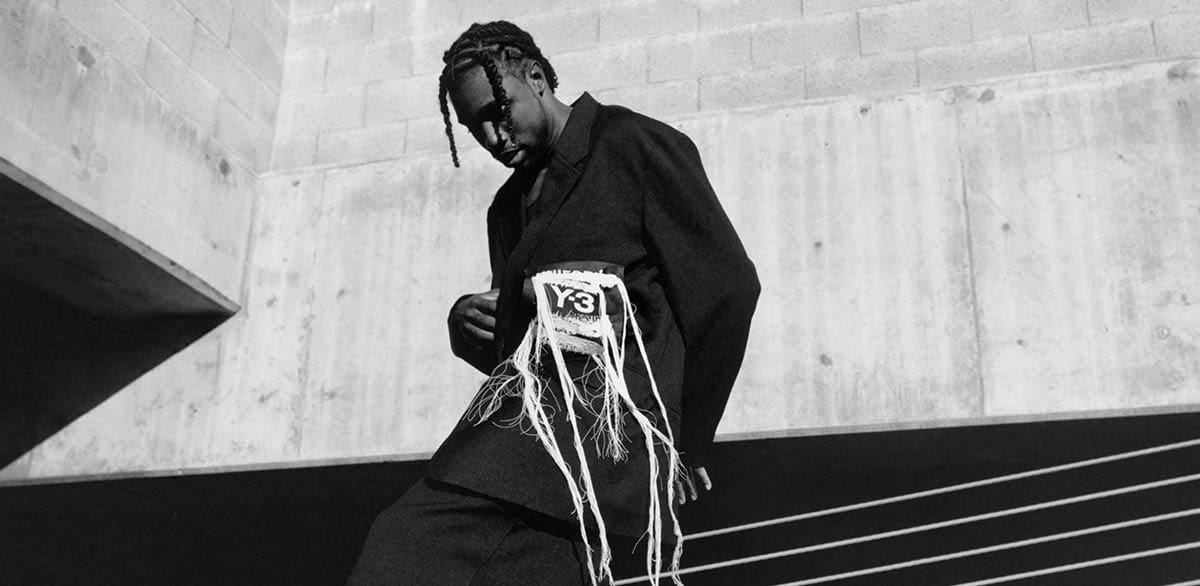
RARE (S)PIECES The Archive Is Alive
ZOO’s Rare (S)Pieces archive as a living record of fashion history, built over decades by identifying and preserving designers and garments whose creativity, experimentation, and cultural influence were recognised before they became widely celebrated. Rather than treating archive pieces as museum objects or investments dictated by trends, ZOO invites collectors to rediscover and wear them today, arguing that a garment’s history is only truly renewed when it finds someone who connects with it
Author:
David - Lead Buyer & Curator at ZOO Fashions
Expertise: Designer Intent, Shifting Luxury Paradigms and Investment Curation. With over two decades of securing ZOO’s Day 1 brand accounts, David curates collections by identifying the designers who dictate the cultural zeitgeist, bridging the gap between high-fashion tailoring and street-level subversion.
There is a moment I think every serious collector can relate to. That something you see on the rail, an item that before you have even touched it, tells you that there is something special there.
Perhaps it is the cut, perhaps the fabric, perhaps the name on the label. Sometimes it is inexplicable, unexplainable, but you just KNOW.
This feeling has been at the heart of ZOO for more than four decades. We’ve always bought clothes because they had something to say. Sometimes loudly, sometimes very quietly, and sometimes they said something that nobody else was quite ready to hear.
That is how an archive begins. No plan, just instinct and a feeling, with somebody saying "Keep that."
That is the foundation of Rare (S)Pieces.

The Legacy of Day One
If you have followed the ZOO Manifesto, you'll know that Day One has never been about being first for the sake of being first. Its recognising conviction before consensus, and seeing a designer who hasn't yet become an institution and asking whether the work contains something that might last.
We've been wrong, of course we have, but we’ve been right often enough to know that the most interesting fashion rarely arrives with a guarantee.
Sometimes it arrives looking strange, difficult, and quite often completely commercially impossible (for that moment). Occasionally it arrives looking like nothing you've ever seen before. These were and continue to be the trigger for the ZOO team to pay attention and what have built the foundation of the Rare (S)Pieces archive.
Items that are all about authorship - who made this decision, why did they make it and most importantly, where could this idea go?

The Ones We Kept
Over the years, there were pieces we didn't sell. Not because we misjudged the buying or were over zealous in our ambitions for the season. More often than not, pieces simply didn't find their customer at the time. Some pieces were too difficult, too directional and ahead of their time. Then there were some that we just couldn’t let go.
From Rick Owens to Raf Simons, to Yohji Yamamoto to Issey Miyake, from Ralph Lauren to Martin Mergiela. Items that have retained and more times enhanced their grailed status. These items are not for everyone. That’s the point and the collector sees things the consumer never will. The sheer nerve required to make a Commes Des Garcon piece, the pleat laden Issey Miyake signature, the all black everything ethos of Yohji Yamamoto, the overly gothic cyberpunk vibe or Rick Owens. When something speaks directly to you, then that is when it becomes yours.
As a mainstay in the decision making process at Zoo for well over 20 years, I’ve always thought fashion sits somewhere very close to modern art. The difference is that you don't just look at it, you put it on. You move around in it, you live it and it becomes an extension of your being. These garments document their time, just like an iconic painting, they challenge proportion, like contemporary sculpture and they can alter your view of everyday familiarities, just like a talented artist.
Not everything is made to please everyone. Something can be beautiful, difficult, provocative, and ridiculous all at the same time. It can be viewed as a failure and conversely brilliant in one breath. That creative process of fashion, between disposable and standing as a cultural phenomenon is where Rare (S)Pieces exists. Preserving the moments when fashion was not simply being produced, but genuinely being imagined.
The Rare (S)Pieces Authors
When you look through the Rare (S)Pieces archive you begin to see a conversation between very different designers. Yohji Yamamoto, Rei Kawakubo, Issey Miyake and Martin Mergiela challenged our understanding of the body, construction, proportion and even the purpose of clothing itself. Raf Simons, Rick Owens and Hedi Slimane transformed menswear through youth culture, music, subculture, silhouette and a radically different understanding of masculinity. Lagerfeld at FENDI, Tom Ford at Gucci and Prada demonstrated how luxury could be rebuilt through material experimentation, technology, sensuality and a willingness to take risks.
John Galliano demonstrated how clothing could become character, theatre and storytelling, whilst Demna showed that clothing could once again become cultural commentary, changing the relationship between luxury, street culture, irony and identity.
Many different designers, many different languages, but the same fundamental quality: Authorship.
Hedi - The Moment Before The World Understood
Perhaps no designer better demonstrates the connection between Day One and Rare (S)Pieces than Hedi Slimane. On 28 January 2001, Slimane presented his first Dior Homme collection, Black Tie.
We have pieces from that beginning. Pieces from that moment.
The narrow silhouettes, the severity, the leather, military references and the ‘new’ physical idea of masculinity. So much of that language feels familiar today that it can be difficult to remember how radical it was, but that's precisely why the archive matters. You can hold the garment and understand that somebody once had to imagine this. This encapsulates the important connection between Day One and Rare (S)Pieces.
At Day One, we were asking whether the idea mattered. Twenty-five years later, we can put the garment in your hands and see what happened next. The archive is the evidence.
Karl Lagerfeld at Fendi - The Laboratory
Our FENDI archive tells another story. The early 2000s were an extraordinary period of experimentation for Karl Lagerfeld at FENDI, particularly around 2000–2003. Think leather, fur, shearling, sellaria construction, exotic materials…We've been studying these garments again recently and some of them are extraordinary.
Leather and fur combined into reversible constructions. A military officer's coat rendered in sumptuous leather. Lamb and goat shearling meeting faux horsehair and wooden buttons. Resin-coated silk treated almost like technical outerwear. These aren't simply luxurious garments, they are experiments through the minds eye of one of the greatest fashion designers, and when you put one on today, you can still feel the question inside it.
Prada, Linea Rossa and Burberry Prorsum
Our Prada and Prada Linea Rossa archive, stretching from approximately 1998 through the 2000s and into the early 2010s, tells another story. Prada was thinking about the relationship between luxury, technology, sport and modern life long before those categories became almost indistinguishable. The same is true of the early Burberry Prorsum pieces we've been bringing back.
A wool coat containing a completely independent lightweight liner, a cotton jacket whose shape can be manipulated through hidden internal toggles, a deep blue lamb shearling pilot coat taking a military archetype and making it luxurious. The interesting thing isn't simply that these garments have been preserved immaculately for a new generation, but that the ideas contained are still workable and as relevant as ever.
Galliano - Clothing As Story
Then there is John Galliano. Arguably the first designer that understood that fashion could transport you somewhere. A concentration on history, romance, theatre, fantasy and exaggeration at the forefront of larger than life collections, but all of when was underpinned by an extraordinary understanding of construction.
His garments were designed to create a world around the person wearing them, understanding that the wearer is always the final part of the design. A viewpoint that still stands alone in its simplicity and owned by Galliano.
Demna - Before The Retrospective
When Demna presented his earliest work, ZOO was there. Not at the grand retrospective, after the museum exhibitions or when the industry had collectively decided that the work was important. At the beginning.
Our Head Buyer, David, recalls that first intimate Paris presentation: “a rooftop near the Palais de Tokyo, shaded netting overhead, drones crossing the sky, an environment that felt almost deliberately makeshift…It felt like the beginning of something.”
Today, Demna’s Balenciaga work has become the subject of retrospective treatment and institutional reassessment. The clothes have become historical objects with a story that has become part of fashion history. This retrospective confirms the significance of what we believed at the time. We were there and we hold the pieces.
The Moment In A Changing Fashion Landscape
These moments are what has built the Rare S)Pieces archive. Their significance is tangible not because they are ‘old’ but because they inherently have captured moments in time.
A change in proportion, a cultural shift or a designer finding their voice. A moment when fashion was moving somewhere and somebody got there early. This is why these items matter. They are physical records of ideas before their time that decades later suddenly look remarkably contemporary.
The importance of maintaining these pieces is ever more pertinent as fashion has changed. Things are faster, more commercial, efficient and disposable. We are in the business, we are part of that shift. But we also understand what happens when commercial and economic certainty becomes the primary measure of value. It is tighter collections, safer edits, homogenised looks and minimal risk. The space to see the creation of future Rare (S)Pieces becomes narrower and narrower.
Some of the greatest fashion ideas began life as things that didn't make immediate commercial sense. They needed time and a willingness to believe in something slightly different. They needed room to be wrong in order to get to something right. This is where fashion finds its future, and this has always been part of ZOO.

Rare (S)Pieces - The Newly Visible Archive
For years, the archive has existed physically, on rails, boxes, back rooms and hanging in garment bags. Kept meticulously because somebody at ZOO believed they mattered.
Now we are giving those garments their second life and Rare (S)Pieces is already doing that online. Every item researched, dated, identified and documented and then put out into the world from East London to be discovered in Tokyo, Melbourne, New York and Paris.
Extinct Drop 001 — Balenciaga.
Extinct Drop 002 — Rick, Raf & Ralph.
Extinct Drop 003 — Maison Martin Margiela.
Extinct Drop 004 — Yohji Yamamoto, Issey Miyake and Comme des Garçons.
These aren't random collections of old stock. They are chapters of different designers, moments and interpretations of what fashion could be, and there is much more in the vault.
Whether you are looking for something specific - a first-era Hedi Leather, a Yohji from the mid-nineties, Prada Linea Rossa, or perhaps you have no idea what you’re looking for - then its time to come and explore, ask questions, try things on at our flagship location, change your mind and discover something you weren't expecting. Rare (S)Pieces isn't a museum, or garments we want you to admire from behind glass. We want you to wear them. Make them yours, as the designer's work is only finished when it meets its owner.
You change it. Your body changes it. Your life changes it. The way you wear it changes it, and suddenly something created twenty years ago becomes completely contemporary again. And that's ultimately the purpose behind ZOO Rare (S)Pieces. We’re not here to tell you what is important, what you should collect or that every piece in the archive deserves your money.
We want to give you the information, the history and the opportunity to make your own decision. These items should empower you and give you the confidence to choose something because you love it, not because somebody told you it was important.
The pieces in Rare (S)Pieces weren't made for everyone.They were made by people with something to say and now you get to decide what they say to you.
And if one of them speaks?
Then perhaps the history isn't finished after all.
RARE (S)PIECES
THE ARCHIVE IS ALIVE.
FAQs
1. What makes a Rare (S)Pieces item worth buying?
These pieces are selected for their rarity, designer authorship, historical significance, and lasting relevance, not simply because they are old.
2. How can I tell if a vintage designer piece is authentic?
Look for details such as labels, construction, materials, season references, provenance, and condition. ZOO researches and documents its archive pieces to help buyers understand what they are purchasing.
3. Which designers and eras should I look for when collecting?
Notable names include Hedi Slimane, Raf Simons, Rick Owens, Yohji Yamamoto, Issey Miyake, Comme des Garçons, Martin Margiela, John Galliano, Prada, Fendi, and Demna.
4. Can I actually wear these archive pieces, or are they mainly for collecting?
They are intended to be worn. ZOO’s philosophy is that an archive garment becomes relevant again when someone makes it their own.